Which courses are better, for your career: courses that focus on skills or courses that lead to a degree?
Posted on Oct 06, 2026 by Schooledge
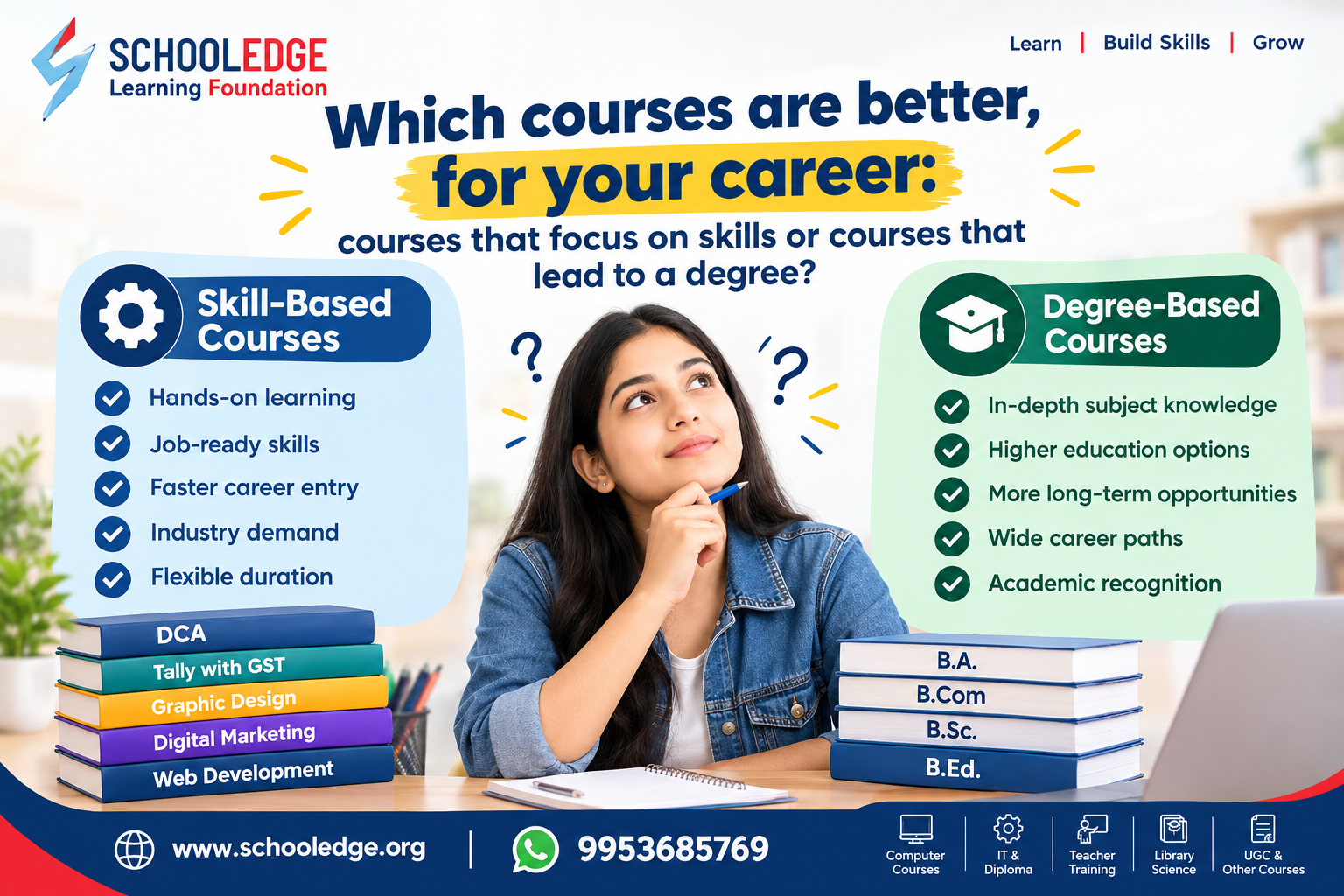
Which courses are better, for your career: courses that focus on skills or courses that lead to a degree?
Choosing what to study after school can feel confusing. Today there are choices and many students find themselves stuck between a traditional degree and a shorter skill?based course.
A degree is still important for jobs especially when a specific qualification is needed. At the time skill-based courses have become a choice. Students who want to learn something and start developing skills that are needed for a career are choosing these courses.
Skill based courses have become a choice. Students who want to learn something and start developing skills that are needed for a career are choosing skill-based courses. The focus is, on learning something and starting to build skills that are needed for a career.
So which one should you pick?
The truth is, there is no answer. It depends on what you want to do in the future how you prefer to learn and what your chosen career actually requires.
In this guide we’ll look at the difference between skill?based courses and degree courses. Help you understand which option may make more sense for your career.
What Are Skill-Based Courses?
Skill?based courses are designed around knowledge. Of spending most of the time studying broad academic concepts students usually spend more time learning skills that can be used in a particular job or professional field.
Skill-based courses have become a choice for students who want to learn something useful and start building skills that are needed for a career. These courses help students gain knowledge and real-world experience. They focus on hands-on learning. Often lead to better job opportunities. Many students today prefer these courses because they see the connection, between what they are learning and what they will do after graduation. It is clear that skill-based education is growing in importance.
The main idea is simple: learn a skill and understand how to apply it.
These courses can be especially useful for students who already have an idea of the type of work they want to do. They can also be useful for working professionals who want to add a skill to their existing qualifications.
What Are Degree Courses?
Degree courses are academic programs offered by colleges and universities. Some common examples include B.Com, B.A., B.Sc., BBA, BCA, B.Tech and many others.
A degree generally gives students an understanding of their chosen subject. Along with knowledge many programs also include projects, practical work, internships or other forms of exposure.
For some careers having a degree is a requirement. It can also be important if you plan to pursue education later.
For example someone who wants to continue with studies may need to complete a bachelor’s degree before moving on to a master’s program.
Skill-Based Courses vs Degree Courses
Both options can help with career development. They serve slightly different purposes.
1. Practical Learning vs Academic Learning
Skill?based courses usually have a focus on practical learning. Students are taught how to use tools perform tasks and apply what they have learned.
Degree programs generally cover a range of concepts and theories related to a subject.
Neither approach is necessarily better. It depends on what you're trying to achieve.
If you want to learn a skill quickly practical training may be more useful. If you want an academic foundation a degree may be the better choice.
2. Course Duration
One major difference is the amount of time involved.
Many skill?based and vocational courses can be completed in a short period although the duration depends on the course and institute.
Degree courses generally take longer. A bachelor’s degree usually requires years of study.
This makes skill?based courses to students who want to start learning a specific skill without committing to a long academic program.
3. Career Focus
Skill?based education is often more focused on a skill or area of work.
For example a student interested in computers might choose training related to computer applications, accounting software, hardware, networking or another specific area.
A degree usually provides an education within a particular field. This can give students time to explore different subjects and career options.
4. Practical Experience
Practical experience matters when you’re looking for a job.
Skill?based courses often include assignments, projects and hands?on training because the focus is on learning how to actually use the skill.
Degree programs can also offer experience through projects, internships and practical classes. However the amount of training can vary considerably from one course and college to another.
This is why students should always look at the curriculum instead of judging a course only by its name.
5. Career Flexibility
A degree can give students a qualification and may allow them to explore different roles within their field. It can also make it easier to pursue education.
Skill?based courses are usually more specific. They can help you become good at a skill but if you later decide to completely change your career direction you may need additional training.
That doesn’t make skill?based education less valuable. It simply means that the two options serve purposes.
Benefits of Skill-Based Courses
For students who enjoy learning skill?based education can be a good option.
Some of its advantages include:
* Focus on job?related skills
* Shorter duration for courses
* Opportunity to specialize in an area
* Hands?on learning
* Useful for improving existing skills
* Can support a career change
* Can be taken alongside a degree or other qualification
For example imagine a student who's interested in computers but doesn’t want to spend years studying only theory. A practical computer course can help that student become familiar with software, applications and other tools that are commonly used in workplaces.
The same idea applies to vocational education, where practical ability is an important part of learning.
Benefits of Degree Courses
Degree courses have their advantages and remain important for many career paths.
A degree can provide:
* A formal academic qualification
* A broader understanding of a subject
* Eligibility for careers that require a degree
* Access to higher education opportunities
* Exposure to subjects and ideas
* Opportunities to build professional connections
For some professions there isn’t really a shortcut around the required qualification. If a career requires a degree completing a short?term course alone may not be enough.
That’s why it is important to check the qualification requirements before choosing your course.
Which Is Better for Getting a Job?
This is probably the question most students have.
Unfortunately there isn’t one answer that applies to everyone.
Some employers require a degree. Others are more interested in what a candidate can do. In cases communication, computer knowledge, practical skills and previous experience can also make a difference.
Think about it this way: having a qualification may help you meet the eligibility requirement but having skills can help you perform the actual job.
Instead of asking, "Which is better for getting a job?" ask:
What does the career I want actually require?
Once you know the answer choosing the combination of education and skills becomes much easier.
Can You Build a Career With Skills Without a Traditional Degree?
Yes, in some fields.
There are industries where practical ability, experience and a strong portfolio can matter more than having a degree. This can include computer?related roles, digital skills, creative work, technical occupations and vocational careers.
However this shouldn’t be taken to mean that degrees are no longer useful.
If the career you’re targeting specifically requires a degree you should not ignore that requirement.
The better approach is to understand the industry and then work on the qualifications and skills it actually values.
Can You Do a Skill?Based Course Along With a Degree?
Absolutely.
In fact for students this can be a very practical approach.
Suppose you’re studying B.Com and want to work in accounting. You could continue your degree while learning accounting software, Excel and basic taxation through training.
Similarly a student studying another subject could learn computer applications, communication skills, digital marketing or another useful skill alongside their education.
This gives you two things: a qualification and practical abilities that you can use in the workplace.
Who Should Choose a Skill?Based Course?
A skill?based course may be worth considering if you:
* Prefer learning by doing
* Want to develop a skill
* Want a shorter learning option
* Already have a career area in mind
* Want to improve your job?ready skills
* Want to add another skill to your existing qualification
* Are interested in vocational education
Before joining any course do not just look at the course name. Check the syllabus, practical training, faculty, institute reputation and what students can realistically do after completing it.
Who Should Choose a Degree Course?
A degree may be a fit if you:
* Want a formal academic qualification
* Plan to pursue higher studies
* Are interested in a career that requires a degree
* Want an understanding of a subject
* Prefer the college or university route
* Want to keep several academic options open
Also do not choose a degree simply because your friends or relatives are choosing the same one.
A course that works well for someone may not be right, for you.
How to Choose the Right Education Path
Still confused? Before you decide take a moment to examine these factors.
1. Start With Your Career Goal
Think about the kind of work you would truly like to do.
You do not need to have your entire life planned out. Having a general direction can make your education choices much easier.
2. Check the Qualification Required
Look at job descriptions and career information for the field you are interested in.
Does it require a degree? A diploma? A certification? Practical experience?
Knowing this beforehand can save you from choosing a course that does not match your career plans.
3. Think About What You Enjoy
You will probably learn better if you are genuinely interested in the subject.
If you enjoy working with computers for example explore computer and IT?related options. If you prefer work look at vocational and technical courses.
Your interests do not have to decide everything. They are worth considering.
4. Compare the Time You Can Invest
Think realistically about how time you want to spend studying.
A longer degree may be the choice for your long?term goal while a shorter skill?based course might make more sense if you want to develop a specific skill quickly.
5. Check the Practical Training
Do not assume that every course offers the level of practical exposure.
Look at the syllabus. Find out whether students actually get opportunities to work on projects use relevant tools or practise what they learn.
6. Research the Institute
This is one step students sometimes overlook.
Before enrolling check the institutes reputation, faculty, curriculum, facilities, practical training and student support.
Do not choose an institute only because the course fee is low or because someone recommended it casually.
Degree + Skills: Why Combining Both Can Be a Smart Choice
You do not have to choose one and completely ignore the other.
For students a degree combined with practical skills can be a strong combination.
For example someone pursuing a commerce degree can learn accounting software and taxation. A student studying any subject can improve their computer skills, communication skills or digital knowledge.
The degree gives you the qualification while additional training can help you become more comfortable with practical work.
This combination can also make your profile more useful when you start applying for jobs.
Final Thoughts
So is a skill?based course better than a degree?
Not necessarily.
Is a degree always better than a skill?based course?
Again not necessarily.
It really comes down to what you want to achieve.
A degree can give you a qualification, broader academic knowledge and a pathway to higher education. Skill?based courses can help you develop practical abilities that may be useful for specific jobs and industries.
For students the best option may actually be a combination of both.
Of choosing a course just because it is popular take some time to understand your career goal the skills employers expect and the qualifications required for that career.
The right education is not simply the course that looks best on paper. It is the one that helps you move closer, to the career you actually want.